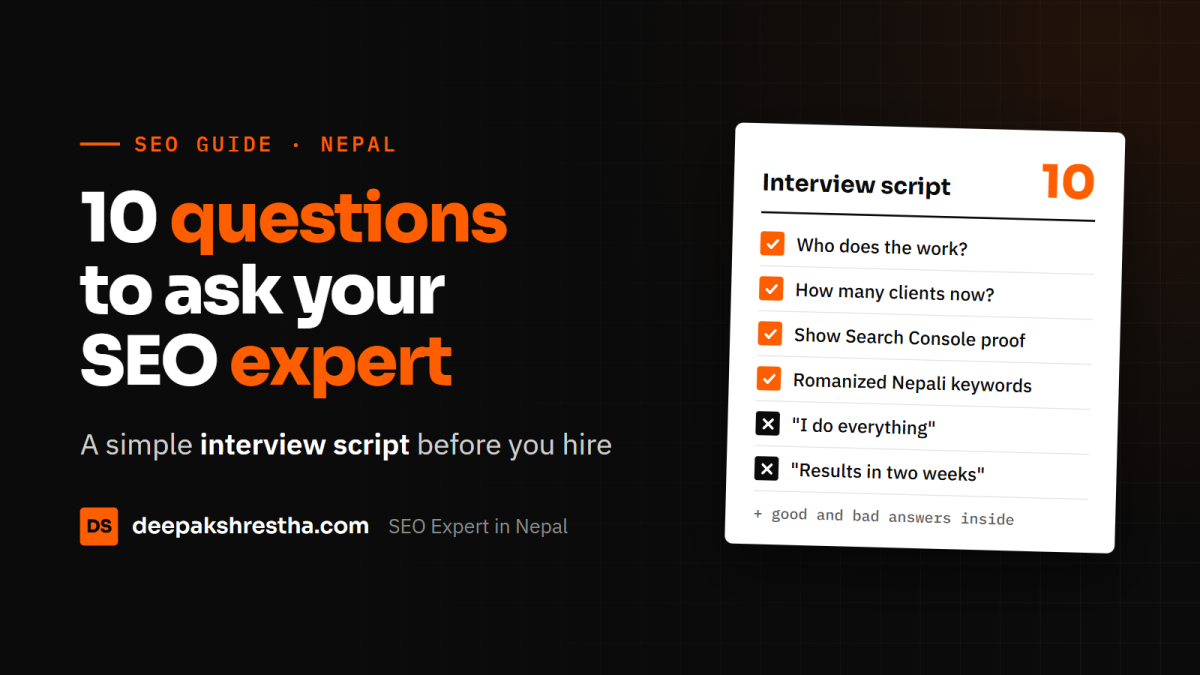
You found an SEO expert in Nepal. Maybe a friend sent his number. Maybe you saw her post in a Facebook group. The price looks fair. The talk sounds smart. But you have been burned before, and you do not want to lose another six months.
Here is the hard part. With one person, there is no office to visit. There is no team to check on. You are trusting one human with your website, your Google account and your money.
So the meeting matters a lot. Most owners walk in and ask only two things: “How much?” and “How fast?” Those are the wrong questions. They tell you nothing about how this person really works.
Below is the interview script I wish every client used on me. Ask all ten questions. Listen closely to the answers. You will know who to hire by the end of one cup of tea.
Quick answer: what to ask before you hire
Ask who does the work, how many clients they have, and what happens when they are busy. Ask to see real Search Console proof. Ask how they handle Romanized Nepali searches. Then ask what they need from you and what they will not do. Finally, ask how you will talk, what the first 90 days hold, and how to end it.
A good expert answers all ten in plain words, without getting upset. A bad one gets vague, promises a lot, or changes the topic.
Before the meeting: why these questions are different
If you are hiring a company, read my guide on what to check before you pay an SEO agency. It covers ranking promises, contracts, backlinks and account ownership. Those checks still matter. I will not repeat them here.
This post is about one person. A freelancer or a consultant. That brings its own risks. One person can get sick. One person can take too many clients. One person can quietly pass your work to someone else. These questions are built to find those problems early.
Tip: take notes during the call. Better yet, ask them to send the key answers in writing after. A good expert will not mind.
The 10 questions to ask an SEO expert in Nepal
1. “Who exactly will do the work on my site?”
Why ask it: Some freelancers sell the job, then hand it to a junior or a cheap helper. You meet one person but get the work of another. That is not always bad. But you should know.
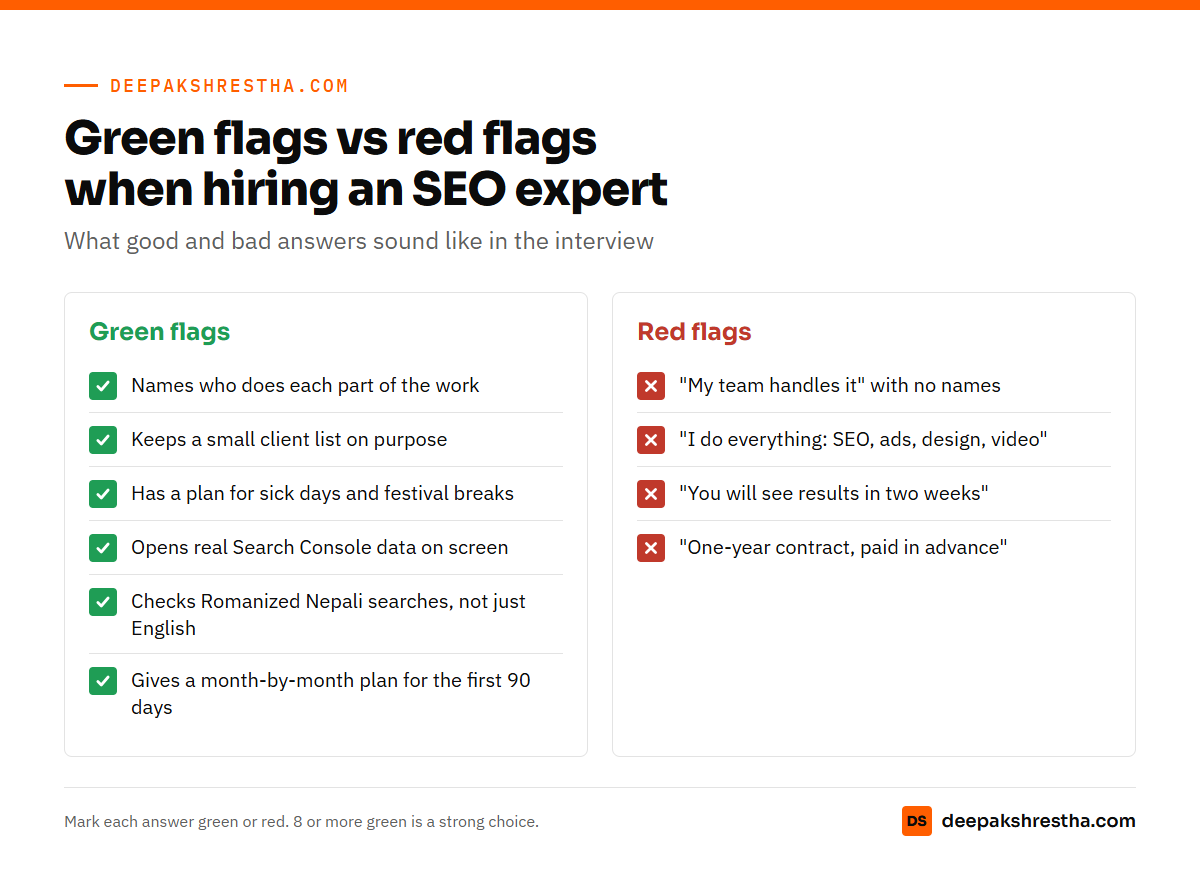
A good answer sounds like: “I do the strategy and the main work myself. A writer helps with blog drafts, and I edit every one.” The person is clear. They name what they do and what others do.
Red flag: “Don’t worry, my team handles it.” Ask who the team is. If the answer stays fuzzy, the work will be fuzzy too.
2. “How many clients do you handle right now?”
Why ask it: SEO takes real hours each month. Pages need fixing. Content needs writing. Reports need thinking. One person can only do so much. If they have 20 clients, you will get very little of their time.
A good answer sounds like: “I keep my list small. That way each client gets proper hours each month.”
Personally, I take 3 to 5 clients at a time for this reason. Other good freelancers set their own limit. What matters is that they have one.
Red flag: “As many as come. I can manage.” That means your site gets a few rushed hours, if you are lucky.
3. “What happens if you are sick, travelling or busy?”
Why ask it: Life happens. Dashain and Tihar come every year. Family weddings take a week. Fevers happen. With an agency, someone else steps in. With a freelancer, you need a plan.
A good answer sounds like: “I tell you ahead of any long break. The monthly plan is written down, so nothing gets lost. You always know what is done and what is next.” That is honest and fair.
Red flag: “That never happens.” Everyone gets sick. A person who says this has not thought about it. You will find out the hard way.
4. “Can I see your own Search Console screenshots, or a past client’s?”
Why ask it: Anyone can show a nice slide. Google Search Console is the free tool that shows real clicks and real search terms. It is hard to fake on a live screen share. Proof from it is worth more than any promise.
A good answer sounds like: “Sure. Here is my own site. And here is a client who gave me permission to share.” They open it live, not as a cropped image. They explain what changed and why.
For example, my homepage shows one client, Himalayan Dog Chew, moving from position 29 to position 1 for “himalayan yak chew”. Ask your expert for real examples like that, and check them yourself on Google.
Red flag: “Client data is private, so I can’t show anything.” Privacy is real. But a good expert has at least one client who said yes, or their own site to show. Zero proof means zero.
5. “How do you handle Romanized Nepali keywords?”
Why ask it: Many people in Nepal search in a mix. They type “kathmandu ma best momo” or “sasto hotel pokhara” in English letters. Tools from abroad often miss these. An expert who only looks at English terms will miss part of your market.
A good answer sounds like: “I check what people really type, in English, Nepali and Romanized Nepali. I look at Google’s suggestions and your own Search Console. Then I pick the ones that fit your page.”
I wrote more on this in writing for Nepali and English searchers.
Red flag: “Nobody searches like that. English is enough.” That person does not know how Nepal searches. Walk away.
6. “What will you need from me each month?”
Why ask it: SEO is not something you buy and forget. Your expert will need photos, answers, approvals and facts about your business. If you cannot give them, the work stalls. Better to know now.
A good answer sounds like: “About one hour a month from you. Approve new pages, share new photos, and tell me about offers or new services. Also reply to Google reviews, or let me help you with that.” Clear and small.
Red flag: “Nothing. Just pay and relax.” That sounds nice. But nobody knows your clinic, hotel or shop like you do. An expert who wants nothing from you is not writing about your real business.
7. “What will you NOT do?”
Why ask it: This is my favourite question. It shows honesty fast. Every good expert has limits. They know what is outside their skill or outside the price.
A good answer sounds like: “I will not buy cheap links or write fake reviews. I don’t run your Facebook posts, that is a separate service. And I won’t promise a number one spot.” Specific limits mean they have thought about it.
Red flag: “I do everything. SEO, ads, design, social, video, all of it.” One person who claims to do it all usually does most of it badly. Or hands it off without telling you.
8. “How do we communicate, and how fast do you reply?”
Why ask it: Most of us live on Viber. But a chat full of voice notes is not a work record. You want quick talk for small things and written notes for big decisions. Agree on this at the start.
A good answer sounds like: “Viber for quick questions, I reply within a working day. Email for anything we decide, so we both have a record. A call once a month to go over the report.” Simple and clear.
Red flag: “Call me any time, day or night.” It sounds kind. It is not real. The same person will stop picking up in month two. The opposite is also a red flag. Think “email only, once a week” and nothing else.
9. “What will the first 90 days look like?”
Why ask it: This shows if they have a real plan or just a sales pitch. The first three months set up everything else. You should know what happens in each one.
A good answer sounds like: “Month one, I audit the site and fix the big problems. Month two, I improve your main pages and your Google Business Profile. Month three, new content starts and first ranking movement often shows.” In my work, first movement usually shows around month 3. Real traffic change takes closer to month 5 or 6.
Red flag: “You will see results in two weeks.” Or the opposite, “Just trust the process,” with no plan at all. Both mean they are guessing.
10. “If this is not working, how do we end it?”
Why ask it: Nobody likes this question. Ask it anyway. How someone plans the exit tells you how they treat people. You want a clean way out, with all your logins and files back in your hands.
A good answer sounds like: “Give me two weeks notice after the first three months. I hand over every login, file and report. You owned them from day one anyway.” That is how I work. No lock-in, and you keep everything.
Red flag: “We sign for one year, paid in advance.” Or worse, silence and a change of topic. If leaving is hard, staying will be hard too.
How to score the answers
After the meeting, sit down for five minutes. Go through the ten questions. Mark each answer green or red.
- 8 to 10 green: A strong choice. Ask for a written proposal.
- 5 to 7 green: Possible, but ask follow-up questions on the red ones.
- 4 or fewer green: Keep looking. Price is not a reason to accept this.
Also notice how they felt about being asked. A good SEO expert in Nepal likes these questions. They are used to them. Someone who gets annoyed or defensive is showing you how they will act when things go wrong.
Price is still part of the choice, of course. If you want to know what fair monthly rates look like, read my guide on SEO price in Nepal. Just do not let price be the only test.
One more thing: ask for an audit first
Before you sign anything, ask for a short written audit of your site. It does not need to be long. But it should name real problems on your real site. Not a template.
This is the best test of all. You see how they think, how they write, and whether they looked at your site at all. I offer a free written audit before any contract for this reason. Want to work with an SEO expert in Nepal who answers in writing? That is where we start.
Frequently asked questions
How do I find a good SEO expert in Nepal?
Start with people who can show real Search Console proof, not only screenshots of rankings. Ask friends in your industry who they used. Then interview two or three people with the questions above. Pick the one who gives clear, honest answers, not the one with the biggest promises.
Is it better to hire an SEO freelancer or an agency in Nepal?
It depends on your size and needs. A freelancer often gives you more direct attention and lower cost. An agency has more people but you may talk to a sales person, not the one doing the work. Either way, ask the right questions before you pay.
How much does an SEO consultant in Nepal charge?
Prices vary a lot based on the work and the size of your site. My own SEO service starts from Rs 25,000 a month. For a full picture of what affects the price, see my SEO price guide. Be careful with very cheap offers, as they often mean rushed or risky work.
What should an SEO expert do in the first month?
The first month is mostly about finding and fixing problems. That means an audit, technical fixes, and a keyword plan based on what your customers really search. You should get a clear written plan for the next two months. Do not expect big ranking changes yet.
Can an SEO expert guarantee first page on Google?
No. Nobody controls Google’s rankings, so nobody can honestly guarantee a spot. A good expert will promise the work, the plan and the reporting instead. If someone guarantees number one, treat it as a warning sign.
Ready to test me with these 10 questions?
I am happy to be interviewed. Bring this list. Ask me every question, and ask for the answers in writing. If you want to hire an SEO expert in Nepal who works with only a few clients at a time, let’s talk.
Start with a free written audit of your website. No contract, no pressure. Request your free SEO audit here, and I will reply on Viber or email, whichever you prefer.